

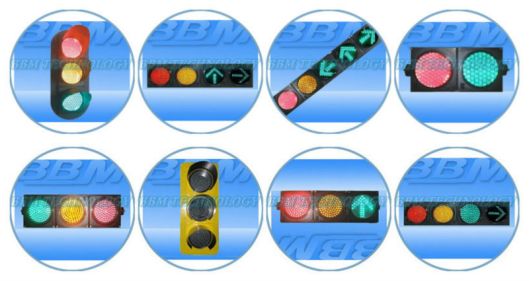


 The usual function of traffic lights needs more than slight control & coordination to make sure that traffic moves smoothly & safely and pedestrians are sheltered when they cross the roadways. A range of diverse control systems are employed to attain this, varying from simple clockwork mechanisms to complicated computerized control & coordination systems that self adjust to lessen delay to people employing the roads.
Phases & stages:
In fact, Traffic signal controllers employ the concept of phases, which are direction of movement grouped collectively. For example, a plain crossroad may have 4 vehicle movement phases: South, West, East and North. There might be supplementary phases for pedestrian movements also.
A stage is cluster of phases which operate concurrently. A plain crossroad might have 2 stages: West & east, South & North. It’s essential that phases in a stage don’t conflict with one another.
Traffic Controller System:
Well, a traffic sign is usually managed via a controller installed within a cabinet. Some electro mechanical controllers are still in action. Nonetheless, contemporary traffic controllers are in solid state. The cabinet usually features a power panel, to allocate electric power in the cabinet; a detector interface panel to link to loop detectors & other detectors; the controller itself; detector amplifiers; flash transfer relays, a conflict monitor system; a police panel to let the cop to deactivate the signal & other components.
In the United States, controllers are standardized by the NEMA, which sets standards for connectors, operating limits, and intervals. The TS-1 standard was introduced in 1976 for the first generation of solid-state controllers.
Solid-state traffic light controllers are needed to possess an independent Conflict Monitor Unit (CMU), which makes sure secure operation. The CMU monitors the outputs of the controller, and if a fault is detected, the CMU uses the flash transfer relays to put the intersection to FLASH, with all red lights flashing, rather than displaying a potentially hazardous combination of signals. The CMU is programmed with the allowable combinations of lights, and will detect if the controller gives conflicting directions a green signal.
Traffic lights should be instructed when to change stage & they are generally coordinated so that the stage changes happen in some relationship to other nearby signals or to the press of a pedestrian button or to the action of a timer or a number of other inputs.
The traffic controller uses input from detectors, which are sensors that inform the controller processor whether vehicles or other road users are present, to adjust signal timing and phasing within the limits set by the controller's programming.

 Traffic signal coordination is when traffic signals are targeted so that traffic can travel along a street without stopping at every light. It’s challenging to do this when dealing with two-way streets, big intersections and lots of traffic.
 Most of the traffic signals at Regional intersections (those are typically the major intersections across Halton) are either semi or fully actuated to keep traffic moving.
 Ever since the signs & messages have been employed outside of businesses to allure the eyes of passerby & distinguish themselves from surrounding competitors, they have been quite effective. Whether they are displaying new productions, promotions or services, or upcoming events, business have been striving every tactic to create awareness & bring customers in. At present outdoor LED signage are employed to do just that. It’s been proven that
  The biggest benefit of
  Traffic lights are an everyday happening but how do exactly they work if they require to be red or green? There’re sensors fitted on the approach to a traffic lamp, either under the road surface or on top of the light itself. These count the number of vehicles that are approaching along the roads & work out which one requires to be green the most.
 1. Green color indicates that it is safe to drive and head in the direction shown by the green signal.
 When it comes to illuminated signage for your business, you have three main choices: neon, fluorescent, or LED. Both neon and fluorescent signs have a long history and have proven themselves reliable, yet lately LEDs have gained attention for their colorful and creative displays.
 As reported by the Small business administration, the united states invested in excess of $14 billion in exterior promoting in 2010-2011. It is no big surprise that LED advertising and marketing is a flourishing market; though it is more and more necessary for a small-business to make a decent internet web site, exterior signs and promoting is also vital that you bring new customers.
 You all know that red means stop, yellow means wait, and green means go. However, a lot of people don’t know regarding the history of
  Timing of the signal is something that plays an exceedingly crucial aspect in all of this. It’s actually what makes this operation & offers people safety in traffic flow. There’re 3 main kinds of signal timing which encompass actuated timing, fixed timing, and coordinated timing. Fixed timing employs the same present time gaps that don’t alter in accordance to traffic volume. And actuated timing employs a detector that’s capable of adjusting itself to diverse traffic volumes. And coordinated timing aids lessen starting & stopping randomly which aids traffic flow & is less expected to make traffic congestion.
 The concept that red means stop & green means go has influenced our lives in multiple ways than merely traffic signals. We’ve been trained from a very young age that the colour red entails danger & green entails it is all right to move head. But why those specific colours were selected for traffic lamps in the 1st place? For something we’ve to glance at daily, why could not they have been beautiful colours like turquoise and magenta.
 As far as red goes, that is always been a colour that hinted danger, long before automobiles were even around. This most probably began because it is the color with the lengthiest wavelength so it can be noticed from a larger distance compared to other colours. As far as yellow goes, it was employed to warn drivers.


