

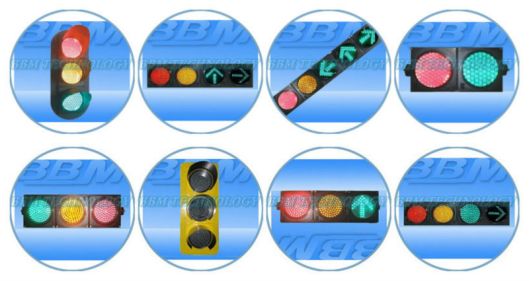


 LEDs are the most advanced standard in traffic signals, mainly due to the Energy Policy Act of 2005 which set minimum standards for energy efficiency in traffic signal and pedestrian modules. The "Vehicle Traffic Control Signal Heads: Light Emitting Diode (LED) Circular Signal Supplement" specification effectively addresses the physical, mechanical, photometric, & electrical requirements for LEDs, encompassing environmental requirements for protecting LEDs from dust and moisture intrusion, including blowing rain. One of the unintended consequences of the transition to LED module traffic signals lenses/indications is the fact that LEDs do not generate heat to the traffic signal lens or face of the traffic signal display. Therefore, LEDs do not provide a "melting" element to traffic signals in the northern climates that experience snow and ice conditions.
Although LEDs typically have a much higher purchase price, they are far more energy-efficient and longer lasting than their conventional counterparts which leads to lower total costs when factoring in electricity savings and reduced maintenance and disposal costs. When compared to available alternatives, LED traffic signal modules are often the best cost value choice because they offer improved visibility; low power consumption, infrequent maintenance and replacement, and, unlike HPS and other mercury-containing street lights, contain no hazardous components that require special care.
 Traffic management professionals around the world are leaving maintenance intensive and energy hungry incandescent lamps by the curb and heading for the robust, high-reliability advantages that LED signal head offer. With up to 90 percent energy savings and a long-rated life, LED signals outshine incandescent traffic signals and offer significant advantages in dealing with sun phantom, light uniformity and color washout issues. Designed for direct retrofit or OEM applications, LED traffic signals are available in designs that can meet current ITE, Caltrans and other key geographic standards.
Sometimes in freezing winter and sometimes in sultry summer, sometimes in sunny days and sometimes in rainy days, the working environment for traffic lights is relatively harsh, thus traffic lights has higher requirement for stability. General lights with incandescent bulbs have an average life expectancy of 1,000 hours, while halogen light bulb have 2,000 hours, so the resulting maintenance costs are high. LED traffic lights lifespan is about 80,000 hours and do not suffer from damages caused by filament shocks or glass broken problems.
From every perspective LED traffic signals are the best option - be it for a busy traffic junction or lesser one. They will definitely create a new revolution in the traffic lighting industry in the near future.

 Have you ever though how LED signage work, but could not comprehend all the technicalities that majority of the LED signage firms use to explain them? Do need to be worried! It is not that tough as you used to believe.
 LED Module: Well, Modules are composed of LED, PCB, IC, resistors, capacitors, connectors, covers and other components by special techniques Modules have matrix of 8×8, 8×16, 16×16, 16×32 and so on, and the corresponding pixels are 64/128/256/512. Pixel pitch is the distance between two adjacent pixels from the center point, such as PH4.75, PH6, PH10, PH16, PH20, and so on. You can see modules are extensively used in


